
Richmond County Scheduled vs Actual Release
Four date terms matter in Richmond County. A county jail release date records when the sheriff released or transferred a person. GDC maximum or projected information comes from state sentence administration. A Tentative Parole Month, or TPM, is a Parole Board planning month. The actual parole or discharge date records the later event that really occurred.
Scheduled is not actual. A TPM is not a final parole decision, and a projected date can change before Richmond County or Georgia authorities complete release.
The difference is especially important for pretrial detention. Someone awaiting court action may leave after bond posts, a judge orders release, charges change, or another agency takes custody. There may be no meaningful date to calculate in advance. A sentenced inmate has more sentence data, but holds, credits, Board decisions, and corrections can still alter the outcome.
Transfer is another source of confusion. Leaving the Webster Detention Center for GDC, another county, federal custody, or an immigration hold is a county release event, but not release to the community. Ask for destination or receiving-agency information when confirming what the date means.
Find a Richmond County Projected Release Date
The proper lookup route follows the person rather than the original arrest. Richmond County's public jail inquiry contains booking and charge information, but research of its visible templates found no projected-release field. State-prison information belongs in the GDC and Parole Board systems.
- Identify whether the person is in the county jail, a county correctional institution, a GDC prison or transitional center, or another system.
- For the Webster Detention Center, open the Richmond County inmate inquiry and record the booking number, arrest date, charges, bond, and disposition.
- Check the Augusta court case for bond orders, sentence language, jail credit, revocation rulings, or a later order that controls release.
- For state custody, use the GDC Find an Offender search with a name, GDC ID, or case information. Review status, facility, sentence, and available release-related fields.
- If parole consideration applies, use the official Inmate TPM Lookup. Read a TPM as the month of final review, not the final release day.
- Register with Georgia VINE for a custody-change notice, then confirm through the sheriff, GDC, Parole Board, court, or written records.
For a named-person search across custody systems, the Richmond County released-inmate records page gives the broader route. Do not use GDC as the first source for someone who simply bonded out of the county jail before entering state custody.
Note: Online absence can mean release, transfer, a spelling mismatch, restricted data, or a delayed update; it does not prove a discharge date.
Richmond County TPM Is Not a Date
The State Board of Pardons and Paroles uses the Tentative Parole Month for inmates in its consideration process. The Board explains that this is when it expects to complete final review and, if appropriate, set a parole release date. A TPM can be postponed or canceled because of misconduct or unmet preconditions such as required programming.
The official TPM explanation is the best starting point before interpreting a lookup result.
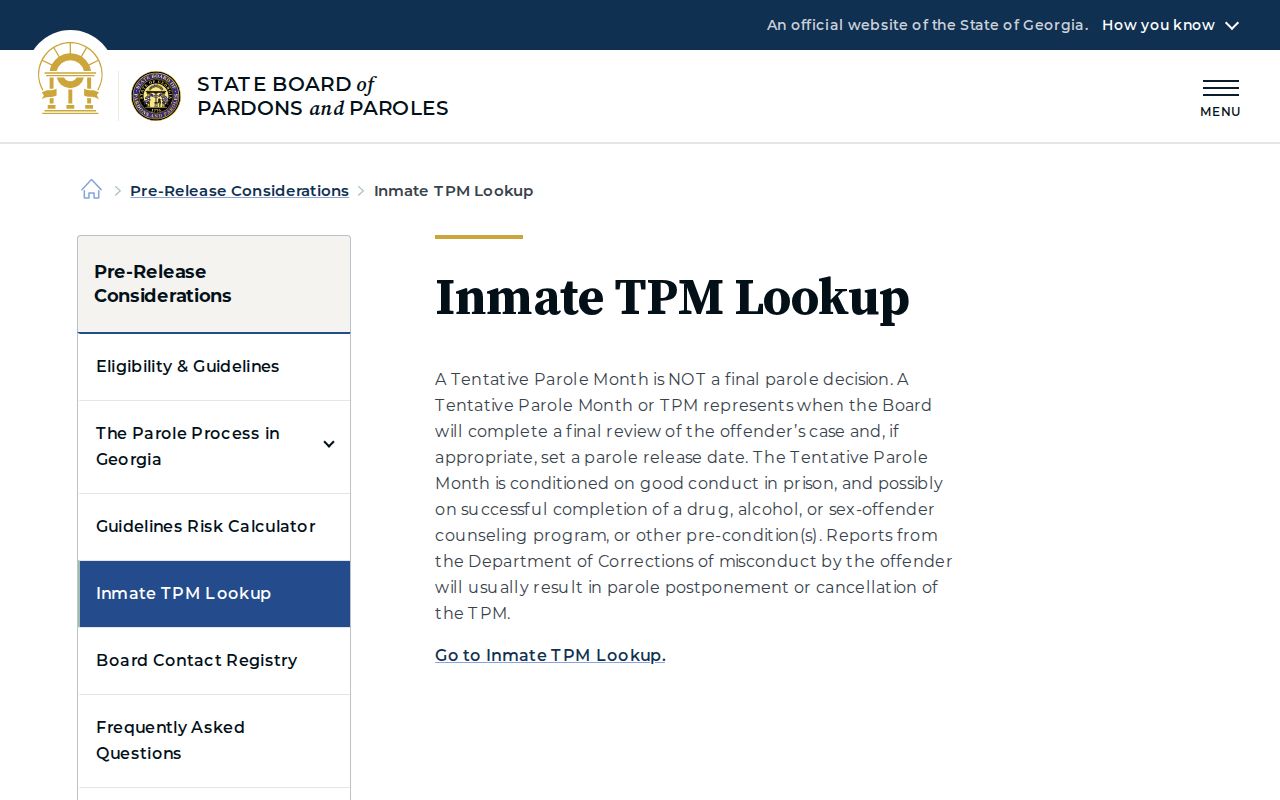
The page shows why a month in the parole system should not be repeated as an exact promised release from a Richmond County-area facility.
The lookup accepts a six-digit inmate number, GDC ID, or personal data. Even a correct match needs context. A TPM applies to parole consideration, not a county-jail bond calculation, and the Board may deny parole or reconsider its prior position before release.
Georgia Credits Affect Richmond County Dates
GDC's Performance Incentive Credit Program, or PIC, can reduce length of stay for eligible state offenders who make satisfactory progress in approved programs, work, treatment, education, vocational activity, and good behavior. PIC points follow a standardized system tied to an individual reentry plan. Eligibility is not automatic, and PIC is not a public Richmond County jail calculator.
The GDC PIC program page explains the state process.
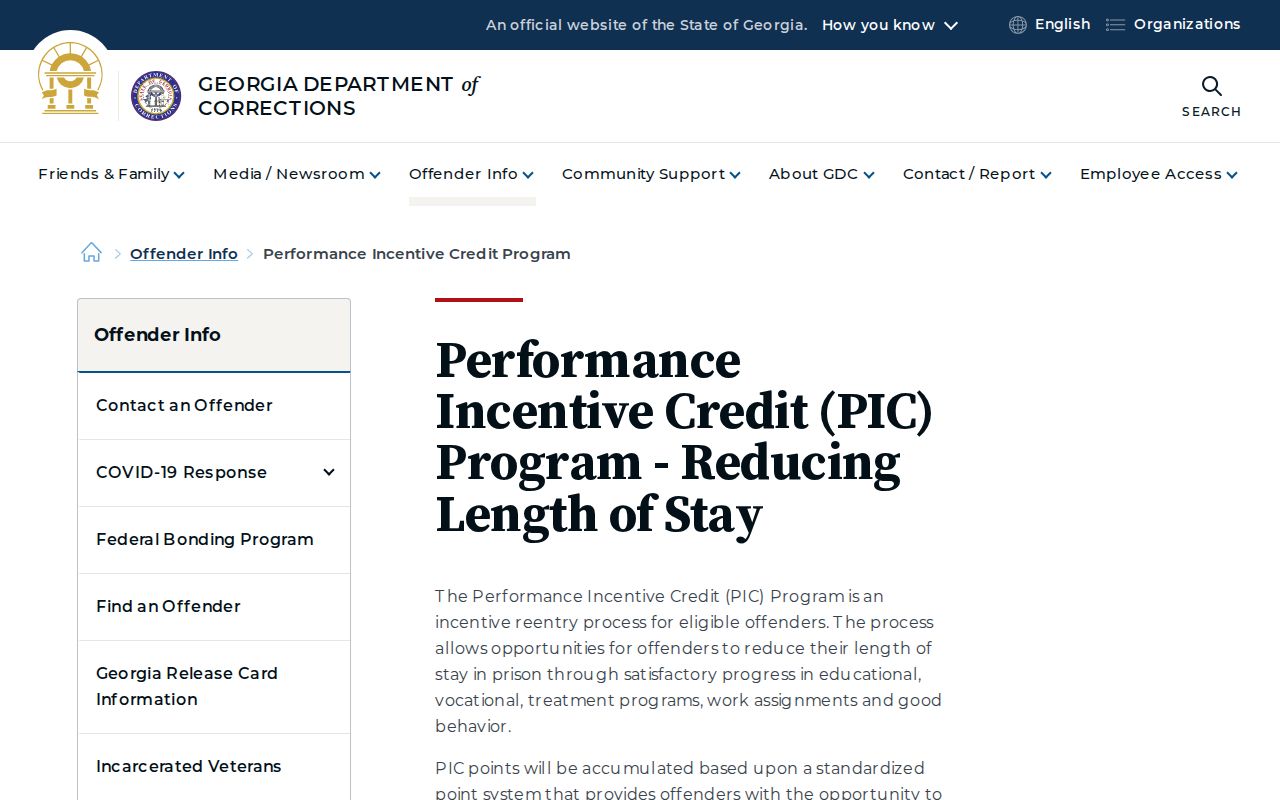
Its focus on eligible state offenders and individualized programming separates PIC from court-set bond or local jail-credit questions.
Parole eligibility is also not the same as release. Under O.C.G.A. section 42-9-45, many felony sentences generally reach parole consideration after nine months or one-third of the sentence, whichever is greater, unless another law changes the rule. For misdemeanors, the general baseline is six months or one-third, whichever is greater. Eligibility only opens consideration; it does not compel the Board to grant parole.
Georgia should not be reduced to an “85 percent” rule. Serious violent felony term-of-years sentences covered by O.C.G.A. section 17-10-6.1(c)(4) require service of every day and carry no parole eligibility under the cited Board materials. Life sentences, recidivist provisions, offense dates, statutory minimums, Board guidelines, and PIC can produce different paths in other cases.
Note: Richmond County jail credit is controlled by the court sentence and sheriff's calculation, not by the GDC PIC program.
Why Richmond County Release Dates Move
A projected date is a working result built from facts that can change. Some changes happen in court, some in corrections, and some because another jurisdiction asserts custody. The releasing agency must apply the current record at the time release is processed.
| Factor | Possible effect | Best confirming source |
|---|---|---|
| Bond or new court order | Creates, advances, delays, or cancels a county-jail release | Court docket and sheriff records |
| Jail credit or sentence correction | Changes the calculated sentence endpoint | Sentencing court and custody records |
| New warrant or outside hold | Prevents community release or causes transfer | Sheriff, court, or receiving agency |
| Disciplinary report | Can affect PIC or postpone/cancel a TPM | GDC and Parole Board |
| Program completion | May affect an eligible state offender's PIC or parole preconditions | GDC and Parole Board |
| Parole decision | Sets, changes, denies, or reconsiders a state release path | Parole Board tools and records |
| Administrative update | Corrects identifiers, credits, status, or displayed dates | Agency that maintains the record |
Probation or parole violation decisions can also return someone to custody or alter the expected path. A booking screen may show a bond amount or disposition without showing the later hold that prevents release. That is why a date remains provisional until the office with custody confirms it.
Richmond County Jail Date Calculation
The Charles B. Webster Detention Center handles local detention and round-the-clock release processing. For a pretrial detainee, the operative event may be bond posting, a judge's order, dismissal, or transfer. For a sentenced county inmate, the court's written sentence, credit for time served, and any later correction or revocation matter more than state PIC.
Use the Augusta Case Management Search and the proper clerk for the case. Court records from Superior, State, Juvenile, and Probate Courts do not come through the general Augusta open-records portal. Sheriff release records belong with the Richmond County Sheriff's Office, while court orders belong with the clerk. Those two records often must be reconciled.
No public calculator: Richmond County's inmate inquiry does not publish a projected-release field. Avoid estimating a date from bond, charge, or sentence fragments.
After release, a focused sheriff request can ask for release date, time, type, and transfer or discharge destination tied to the booking number. If the person entered GDC custody instead, continue through the state offender record rather than treating the county transfer date as final discharge.
Confirm the Richmond County Release Event
Georgia VINE can provide an automated custody-change notice, but it is not a certified release certificate. Register after locating the correct person, save the identifying information, and compare any notice with the source agency. The Richmond County VINELink check guide explains the specific-inmate and notification steps.
For a county release, contact sheriff records and compare the court docket. For a state release, check GDC, TPM or parolee tools, and DCS if supervision follows. GDC's online disclaimer directs users to verify through written correspondence with Inmate Records and Information at P.O. Box 1529, Forsyth, GA 31029 before treating displayed details as complete.
A final confirmation should say what happened, not only that a person left one list. Record the actual release date and time when available, the release type, and whether the destination was the community, GDC, another county, federal custody, or another authority.
Public Record Search
Sponsored Results