
Richmond County Release Meaning
“Released” means one agency's custody ended. It does not always mean the person returned to the community. At the Charles B. Webster Detention Center, release can follow bond, time served, a court order, dismissal, sentence completion, or transfer. A transfer to the Georgia Department of Corrections, another county, federal authorities, or immigration custody ends the local jail stay while custody continues elsewhere.
The Richmond County Sheriff's Office holds the county booking and release trail. Courts hold the order, disposition, or sentence behind the change. GDC covers state offenders. The State Board of Pardons and Paroles and Department of Community Supervision document parole and felony probation. BOP and ICE operate separate federal systems. Once a name drops off the current jail roster, the release record and the next agency become more useful.
- Discharge
- The end of confinement or sentence custody shown by the responsible agency.
- Time served
- Release based on custody credit ordered by a court.
- Parole
- Community release before a state sentence ends, under Board authority.
- Probation
- A court sentence served in the community, sometimes after jail time.
- Detainer
- A hold that can send a person to another agency.
Richmond County Release Types
A Richmond County release entry must be read with its reason. Bond can end local detention while the case continues. Time served reflects a court sentence and credit calculation. A dismissal may end one charge while other holds remain. Parole and probation create supervision records. Transfer entries point toward the receiving agency.
| Type | Meaning | Next record |
|---|---|---|
| Bond or recognizance | Pretrial custody ends while the case continues. | Court docket and sheriff record |
| Time served | The ordered jail term and credit are complete. | Sentence and jail release record |
| Court order or dismissal | A case action authorizes release. | Certified court disposition |
| Parole or probation | Community supervision begins. | Parolee search and DCS |
| Agency transfer | County custody ends at a handoff. | GDC, BOP, ICE, or receiving agency |
Richmond County Release Record Fields
The public inmate inquiry supplies booking clues, not a full release certificate. Its list shows name, race, sex, age, and arrest date. Detail adds the booking number, charges, bond, and disposition. No explicit release-date column appeared in the researched interface. Disposition text can explain a charge result, but it is not the exact jail exit time.
| Field | What it establishes |
|---|---|
| Name and booking number | The correct booking event |
| Arrest and release date/time | The local custody period |
| Release reason | Bond, discharge, court order, or transfer |
| Bond and disposition | Charge and court context |
| Destination | Whether another agency took custody |
| Court case number | The order behind the release |
No published online retention rule guarantees every old Richmond County booking remains searchable. Older results are leads. Formal proof should come from the sheriff or court, and restricted information may be withheld or redacted.
Request Richmond County Release Records
Use the sheriff open-records request. A narrow request is easier to identify and avoids asking the office to create a custom report.
- Find the legal name, arrest date, and booking number.
- Ask for the existing release date, time, reason, and destination.
- Add the court case number and request electronic records when available.
- Submit through the sheriff form or RCSOOpenRecords@augustaga.gov. Official pages list 706-821-1004 and 706-821-1076 for open-record contacts.
- Request the court disposition from the Clerk when an order caused release.
400 Walton Way
Augusta, GA 30901
706-821-1010
Monday through Friday, 8:30 a.m. to 4:30 p.m.
Georgia law sets a three-business-day response framework when records are not immediately available. The first quarter hour of search, retrieval, and redaction is free. Later labor may be charged at the prorated rate of the lowest-paid qualified employee. Copies may cost up to ten cents per letter or legal page. Cost notice is required above $25, and prepayment may be required above $500.
Richmond County Release Record Law
The Georgia Open Records Act, including O.C.G.A. section 50-18-71, supports access to existing public records unless an exemption or court order applies. An office need not create a new 72-hour release report if none exists. Juvenile, sealed, restricted, medical, victim, informant, and security-sensitive details may be limited.
Georgia calls expungement “record restriction.” The GBI guidance says arrests after July 1, 2013 are handled through the prosecutor. Older arrests require an application to the arresting agency. A person correcting Richmond County history should compare the sheriff booking, court disposition, and restriction order before contacting the sheriff, Clerk, prosecutor, GBI, or GDC.
Find Richmond County Released Inmates
Richmond County does not publish a labeled recent-releases list. Its official app offers Recent Bookings and a name search. A missing result can be consistent with release, but does not prove it because records can lag and transfers look similar.
- Search the sheriff inmate inquiry and open the correct booking.
- Compare arrest date, booking number, charges, bond, and disposition.
- Check the court docket for the order that explains the custody change.
- For a state sentence, search GDC, then parole and DCS records.
- Use Georgia VINE for custody-change alerts, not as a certified record.
- Check BOP or ICE when a federal or immigration transfer is plausible.
- Request the sheriff release fields when online sources do not settle the question.
Leaving the active jail roster is a clue, not proof that the person returned to the community.
Georgia Search for Richmond Releases
The GDC offender search is the statewide path for sentenced state offenders. It is not a Richmond County pretrial roster. Results may include status, identifying data, sentence information, current or last facility, and release or supervision information. GDC asks users to confirm key facts in writing with Inmate Records and Information.
| Field | Use |
|---|---|
| Name | Start the state search |
| GDC ID | Separate similar names |
| Age or birth date | Match identity |
| Status | Distinguish custody from release |
| Facility and sentence | Confirm the state custody lane |
The official search page shown below is a state source for Richmond County offenders who entered GDC custody.
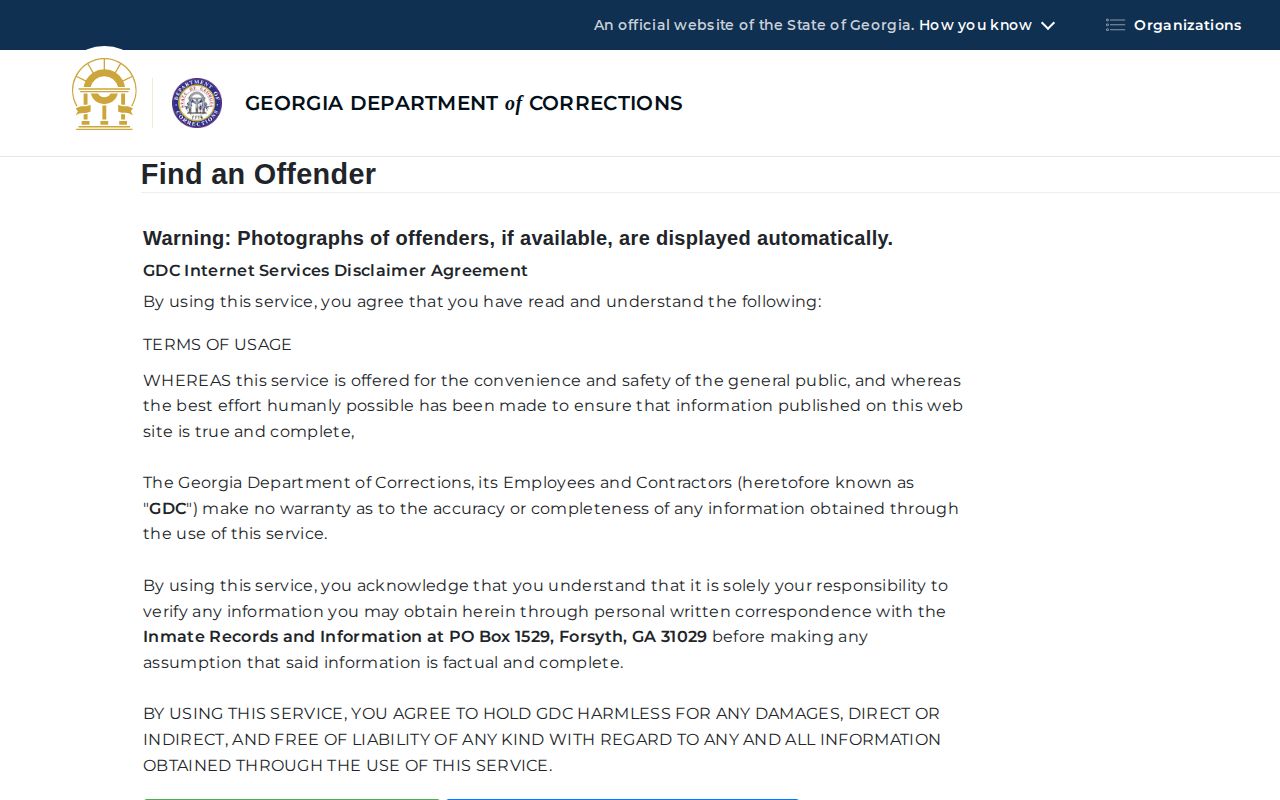
Compare a released or discharged status with parole information and the original county booking when the custody path crossed systems.
Richmond County Release Feed Limits
The official inquiry provides Recent Bookings, not Recent Releases. Its visible service calls include GetRecentBookings, SearchBookings, and GetBookingDetail. Research found current and prior-day arrests but no defined 24-hour or 72-hour window. The observed template showed no release date, time, reason, housing location, or personal mugshot.
Use the feed to identify the booking, then move to the name search, court file, VINE, or sheriff request. Older entries may appear, but no official retention schedule promises a complete archive. A just-processed release may also take time to reach connected systems.
Richmond County Release Supervision
Parole follows a prison release authorized by the State Board of Pardons and Paroles. Probation is ordered by a court. DCS handles parole and adult felony probation through the Augusta field office. The Parolee Database can help verify parole, while DCS answers local supervision questions.
Augusta Transitional Center creates a crucial local distinction. A resident may work in the community while still living at the center and remaining in GDC custody. Community presence does not prove final discharge. GDC status, the Parole Board, and DCS show whether the person is on parole, probation, discharged, or still in transitional custody.
Richmond Release Alerts and Transfers
Georgia VINE provides online, phone, and mobile custody notifications. It can report a change supplied by an agency, but it is not the certified sheriff record. Coverage depends on agency feeds. Match the person, facility, and offender or booking number.
The BOP locator covers federal inmates from 1982 forward. A past release date with no facility generally means the person is no longer in BOP custody, though supervision or another system may follow. ICE has a separate locator for current immigration custody. Neither proves a community release from Webster. They help reveal whether a federal or immigration transfer followed the county exit.
Compare Richmond County Release Sources
Each system answers one part of the custody path. Matching source to agency prevents a transfer from being mistaken for freedom.
| Source | Best use | Limit |
|---|---|---|
| RCSO inquiry | County booking clues | No explicit release field observed |
| Sheriff record | Exit time, reason, destination | May require a request |
| Court file | Bond, sentence, disposition | Case may continue after release |
| GDC search | State custody and discharge | Not the county roster |
| VINE | Custody-change alerts | Not a certified certificate |
| BOP or ICE | Federal custody | Separate from county records |
Richmond County Release Facilities
Richmond County has several custody layers. Webster is the county detention center. RCCI houses state and county offenders. Augusta Transitional Center is a GDC pre-release setting. Augusta State Medical Prison is a state prison. DCS Augusta is a supervision office, not a jail. Federal and immigration custody stay separate.
- Charles B. Webster Detention Center: county release records and courts.
- Richmond County Correctional Institution: facility, GDC, parole, and DCS records.
- Augusta Transitional Center: community work can precede final release.
- Augusta State Medical Prison: state discharge and parole channels.
- Augusta DCS Field Office: parole and felony-probation supervision.
- Federal / Immigration Custody Channels: BOP, ICE, and federal courts.
The facility name matters. “Released in Augusta” can mean county discharge, state parole, transitional custody, or transfer.
When Richmond County Releases Happen
The sheriff jail division says the Webster Processing Center receives and releases inmates around the clock. A person can leave after the Records Bureau counter closes. Release operations and records-office access are separate, so an overnight release may not be confirmed by a clerk until the next business period.
Record the booking number and use VINE while waiting for formal confirmation. The round-the-clock process also means a morning roster can differ from one checked late the prior night.
Richmond County Release Turnover
The sheriff reports an FY2024 average daily inmate population of 1,165 at Webster and total bed capacity of 1,050. These figures do not state annual release totals. They do show the scale of local booking, bond, transfer, and release activity, which helps explain why custody status changes during the day.
Richmond Release Court Routing
Augusta's open-records instructions route sheriff records to the sheriff, but exclude Superior, State, Juvenile, and Probate Court records from the general portal. Ask the Clerk or relevant court for the release-causing order. A bond release can occur before the final case result, and a conviction can later result in probation or time served without another jail stay.
Release alone does not prove dismissal or innocence. The court file may show dismissal, nolle prosequi, acquittal, conviction, probation, revocation, or sentence completion. Read the sheriff exit record and court disposition together.
Richmond Transitional Release Status
GDC describes transitional centers as community residential services before parole or discharge. Augusta Transitional Center residents may hold paying jobs in the community while living under center rules. Seeing someone at work or elsewhere in Augusta is therefore not proof that GDC custody ended.
Confirm the state status in the GDC offender search. Then check the Parole Board if parole is involved and DCS if community supervision follows. Final discharge, parole, and transitional-center custody are separate stages.
Richmond County Release Layers
Charles B. Webster Detention Center, Richmond County Correctional Institution, and Augusta Transitional Center have different roles. Webster handles county detention and local processing. RCCI houses state and county offenders and supports local work details. The transitional center is a GDC pre-release residence. One Augusta-area name search can therefore cross county, state, and supervision systems.
Start with the facility shown on the booking or offender record. That fact decides whether RCSO, GDC, the Parole Board, DCS, BOP, or ICE holds the next record.
Correct Richmond County Release Records
Record restriction can change public access to an older arrest or criminal-history entry. For arrests after July 1, 2013, GBI directs people to the prosecutor. For earlier arrests, the application starts with the arresting agency. A restriction order may not erase every historical trace at once.
Compare the official booking, the court's final disposition, and any signed restriction order. Then send the correction to the agency that controls the disputed record. This may be the sheriff, Clerk, prosecutor, GBI, or GDC.
Verify Richmond State Releases
GDC's search disclaimer directs written verification requests to Inmate Records and Information at P.O. Box 1529, Forsyth, GA 31029. A useful request identifies the person by full name and GDC ID, then asks for the release date, release type, last facility, sentence discharge or parole status, and supervision office when those fields are public. The GDC contact line for inmate questions is 404-656-4661.
Written verification matters when the online status is unclear or appears inconsistent with a Richmond County booking. County release can mark the transfer into GDC, while the later GDC release marks the end of state confinement. Those dates describe different events. If parole follows, the state sentence may continue under supervision even though prison confinement has ended.
A Tentative Parole Month is also not an actual release date. The Parole Board can postpone or cancel it during final review. For that reason, use the GDC record, Parole Board result, and DCS supervision status together when the question is whether a Richmond County state offender has truly left confinement.
Trace Richmond County Release Orders
Start with the event that could legally change custody. A bond order may permit release once the required bond is posted and other holds clear. A sentence can result in time served after the sheriff applies the court's jail-credit direction. Dismissal of one charge may not end custody when another charge, warrant, probation matter, or detainer remains. The booking detail's charge and disposition lines help identify these possibilities, but the court file gives the fuller explanation.
Superior Court has exclusive felony jurisdiction in Georgia. State, Magistrate, and other local courts handle different misdemeanor, warrant, preliminary, traffic, and limited-jurisdiction matters. A felony release may begin with a magistrate bond event and later appear in Superior Court. A misdemeanor booking may lead to a State Court or Magistrate Court record instead. Use the charge and case number to choose the court rather than sending every request to one clerk division.
When the case result and jail status seem to conflict, compare dates. A person can leave on bond before conviction or dismissal. Someone can later receive probation, fines, or time served without returning to confinement. Conversely, a court may enter a release order while another agency hold prevents a community exit. Ask the sheriff for the release reason and receiving agency, then ask the court for the order and certified disposition. Together, those records distinguish an authorized jail exit from the final outcome of the criminal case.
Public Record Search
Sponsored Results