
Federal Custody Destinations
Federal and Immigration Custody Channels is the main Richmond County detention center. Leaving its active population does not always mean a person went home. The sheriff may release someone after bond posts, after a local sentence ends, because a judge orders release, or after charges are resolved. The same jail action can instead document a handoff to the Georgia Department of Corrections, another county, the U.S. Marshals Service, or immigration authorities. The destination and release type matter as much as the time the person left.
A person released to the community may no longer appear as a current inmate. An older booking can still turn up by name, but the online inquiry is not a guaranteed archive. When a transfer occurred, continue in the receiving agency's system. Use the GDC Find an Offender search for state custody, the BOP locator for federal custody, and the ICE locator when an immigration transfer is indicated. The broader Richmond County released inmate search explains how those lanes fit together.
Federal Release Record View
The BOP explanation of inmate records shows how federal release dates and custody locations are read.
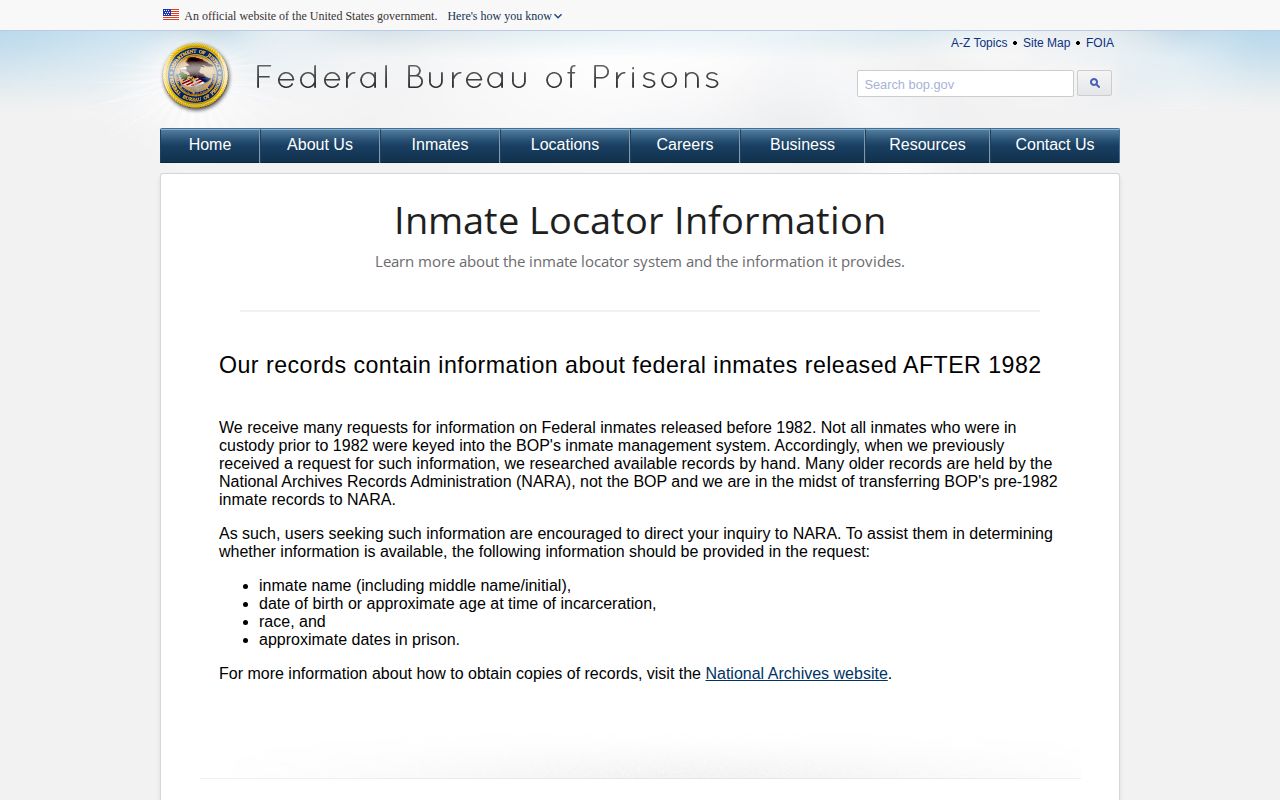
The locator record must still be checked for a current facility, a past release date, and any separate supervision or custody system.
\n
Confirm a Federal Custody
The Richmond County Sheriff's Office inmate inquiry is the first online check. Its public application offers Recent Bookings and a name search. Search results show last name, first name, race, sex, age, and arrest date. Opening a booking adds the booking number, full name, charges, bond, and disposition. Those details help identify the right person, but the observed interface does not show a clear release date, release time, or release reason.
- Search the exact last and first name, then compare age and arrest date.
- Open the likely booking and record its booking number, charges, bond, and disposition.
- Check Georgia VINE for a custody-change notice tied to the same person and agency.
- Review the relevant Richmond County court docket for the bond, sentence, dismissal, or release order.
- Ask sheriff records for the release date, time, type, and destination when the online clues do not settle the question.
Do not treat absence from a current result as proof of release. The spelling may differ, the data may lag, or the person may have transferred. A disposition such as bond or time served is also not a complete jail release record. Match the booking number and court case before drawing a conclusion.
Federal Custody Records
Formal confirmation comes from the sheriff's records channels. Use the RCSO open-records request and ask for existing facts tied to one booking. A useful request provides the full name, booking number, arrest date, and any known court case number. Ask for the date and approximate time of release, release reason or type, and receiving agency if the event was a transfer. Narrow wording helps staff locate the correct record and avoids asking the agency to create a new report.
400 Walton Way
Augusta, GA 30901
706-821-1010
Monday through Friday, 8:30 a.m. to 4:30 p.m.
Open-records questions may also be sent to RCSOOpenRecords@augustaga.gov. Official pages list 706-821-1004 for Augusta sheriff-record routing and 706-821-1076 for the sheriff open-records contact. Georgia law generally provides a three-business-day response framework when records cannot be produced at once. Charges may include qualified staff time after the first quarter hour and permitted copy costs. The agency may redact protected material or cite a legal basis for withholding it.
| Requested field | Why it helps |
|---|---|
| Booking number | Separates repeated arrests and similar names |
| Release date and time | Confirms when local custody ended |
| Release type | Distinguishes bond, time served, court order, and transfer |
| Destination agency | Shows whether another custody system took over |
Federal Release and Transfer Timing
Federal timing is controlled by the federal sentence, Bureau of Prisons calculations, court orders, and any later detainer. The BOP warns that release dates may change as sentences and federal time credits are reviewed. A Richmond County transfer entry records only the local handoff and does not set the later BOP release date.
ICE custody follows a separate administrative system. Its Online Detainee Locator covers a person currently in ICE custody or in CBP custody for more than 48 hours. A missing result does not prove community release. ICE facility contacts, counsel, or the appropriate field office may be needed when identifiers or feed timing prevent a match.
USMS custody may bridge a local jail and federal court or BOP designation. In that situation, federal court records, the BOP locator after designation, and the county transfer entry answer different parts of the timeline.
Read BOP and ICE Status Carefully
The BOP inmate locator covers federal inmates incarcerated from 1982 to the present. BOP explains that when a listed release date is in the past and no facility location appears, release occurred on that date and the person is no longer in BOP custody. That does not rule out supervised release, parole, or custody in another criminal-justice system.
ICE searches work best with an A-number and country of birth, or exact biographical details. BOP searches use federal identifiers or name details. Common names and mixed local/federal cases can mislead, so compare dates, agency, facility, and court case before deciding that a result belongs to the Richmond County person being researched.
Richmond Facility Cluster
Federal is one part of a notably dense Augusta release system. It is distinct from Richmond County Correctional Institution, which holds state and county offenders; Augusta Transitional Center, a GDC residential work-release setting; and Augusta State Medical Prison, a close-security state facility. The Augusta DCS Field Office supervises some people after release but holds no inmates.
| Place | Correct starting route |
|---|---|
| Federal or ICE custody | Sheriff inquiry and sheriff release record |
| Richmond County Correctional Institution | GDC offender search and institution records |
| Augusta Transitional Center | GDC status, parole, and DCS supervision |
| Augusta State Medical Prison | GDC offender and state release records |
| DCS Augusta Field Office | Community supervision verification |
Using the wrong roster can hide the answer. A state offender does not become a Federal inmate simply because the facility is in Richmond County. Likewise, a former Federal detainee will not appear in GDC unless state custody later began.
Federal Court Record Check
Richmond County court records can explain what caused the jail event. The Augusta Case Management Search may show case numbers, hearings, charges, dispositions, and sentence events. Internet entries are useful leads, but the clerk is the source for certified copies. A bond order can precede the end of the case. Release does not by itself mean a charge was dismissed.
Augusta's general open-records portal does not handle Superior, State, Juvenile, or Probate Court files. Request those records from the Clerk of Superior, State and Juvenile Court. Compare the court case number with the sheriff booking number. Together, the records can show the judicial basis for release and the operational time the jail carried it out.
- Disposition
- The recorded outcome of a charge or case.
- Transfer
- A move into another agency's custody, not community release.
- Time served
- A sentence satisfied by custody time already credited.
- Detainer
- A request or hold from another authority that may prevent community release.
Verify a Richmond County Federal Handoff
A local release record and a federal record often describe two consecutive events. First, the Richmond County Sheriff's Office records when its custody ended and may identify a federal hold or receiving authority. Next, a federal court, USMS, BOP, or ICE record shows what happened after the handoff. Neither record should be forced to answer the other agency's part of the timeline.
- Record the Richmond County booking number, release or transfer date, and receiving agency when available.
- Search the federal court case when the person faced a federal warrant, indictment, or sentence.
- Use the BOP inmate locator for a person who entered or previously served a federal prison sentence.
- Use ICE's Online Detainee Locator with the A-number and country of birth or exact biographical details.
- If USMS custody preceded BOP designation, use the court record and appropriate federal contacts while waiting for a BOP location to appear.
- Confirm whether the final event was community release, supervised release, removal proceedings, transfer, or continued custody.
No official source reviewed for Richmond County identified the Webster Detention Center as a dedicated ICE detention facility or confirmed routine ICE contract detention there. ICE is therefore a transfer and fallback channel on this page, not a claim that the county jail operates an immigration detention program.
Federal Release Does Not End Every Obligation
BOP's statement that a person is no longer in BOP custody does not establish that every criminal-justice obligation has ended. The person may begin federal supervised release, face a state or local hold, enter immigration custody, or remain subject to another sentence. Federal court records identify supervised-release terms and later modifications or revocation proceedings.
ICE status needs the same care. The locator is meant to locate covered detainees, not to certify every immigration outcome. A person may have been released under immigration conditions, transferred, removed, or placed in a process that is not fully explained by a single public result. Use ICE facility contacts or counsel when the locator and local transfer record do not resolve the question.
Keep each date with its source: Richmond County custody end, federal court action, USMS movement, BOP release, or ICE custody change. That source-by-source timeline is more accurate than describing the earliest departure as the final release.
Public Record Search
Sponsored Results